
What Is an In-Place Inclinometer?
An automated inclinometer, also known as an In-Place Inclinometer (IPI), is a geotechnical instrument used to monitor lateral ground movement and structural deformation automatically. Installed permanently within inclinometer casing, IPIs provide continuous measurements that help project teams identify movement trends and potential risks.
IPIs help project teams identify where deformation is occurring, how much movement has developed and how it changes over time. The instruments are commonly installed within inclinometer casing in boreholes, retaining walls, piles and other geotechnical structures.
Multiple sensors can be positioned at selected depths to create a displacement profile of the monitored area. In-place inclinometers are used across infrastructure, construction, mining and asset management projects in Australia and New Zealand.
Their automated operation makes them particularly useful when frequent measurements or rapid access to monitoring information is required.
What Does an In-Place Inclinometer Measure?
An in-place inclinometer measures changes in inclination at selected locations below ground or within a structure. These angular measurements are converted into lateral displacement values.
When several sensors are installed at different depths, the results can be combined to produce a deformation profile. This allows project teams to monitor:
- The location of lateral movement
- The magnitude of displacement
- The direction of movement
- The depth of movement
- The progression of deformation
- Changes in the rate of movement
The resulting information helps stakeholders understand how the ground or monitored structure is responding during construction and operation.
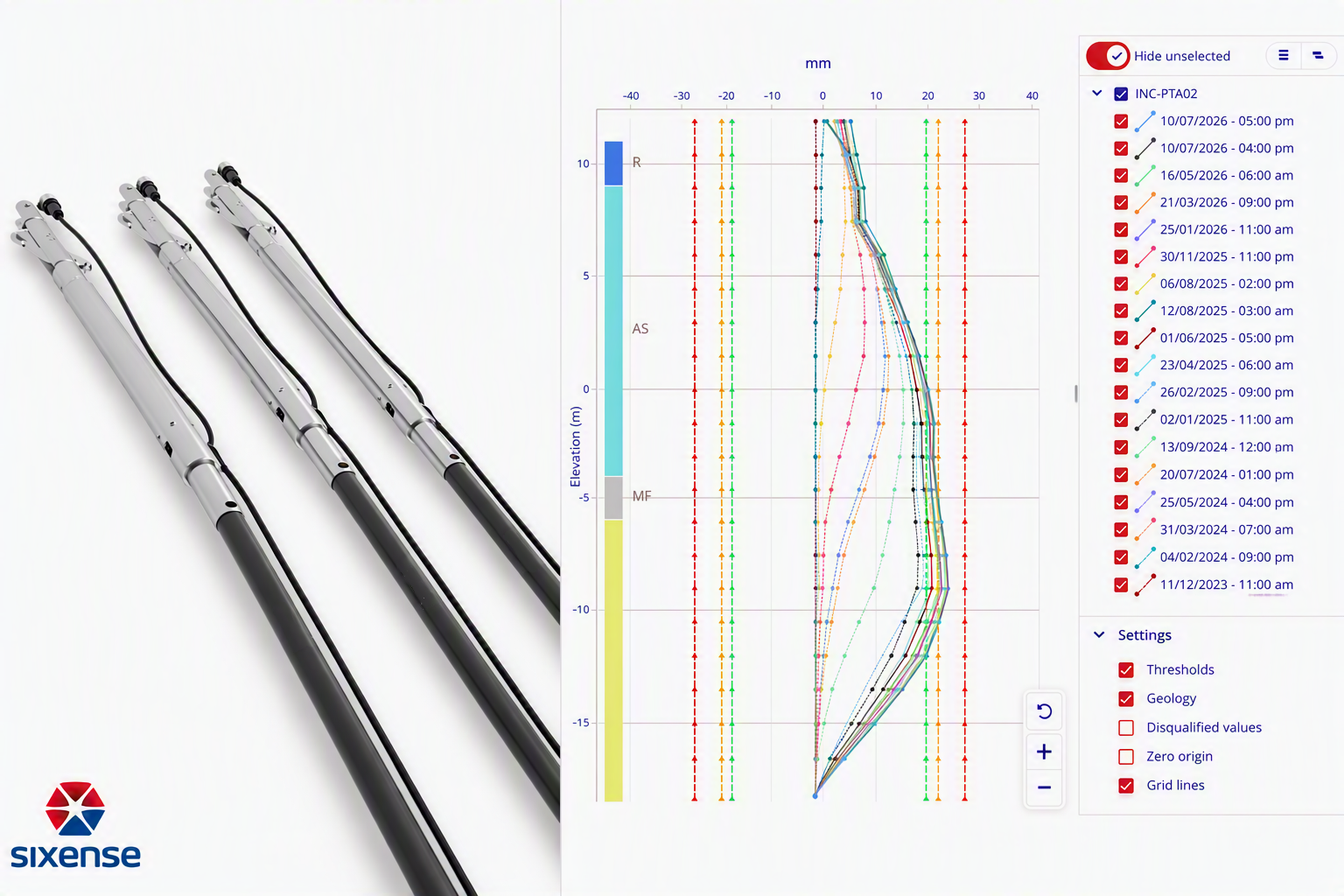
Image: Real-time data from Automated Inclinometers on Beyond Monitoring®
How Does an In-Place Inclinometer Work?
An IPI system typically consists of a series of connected tilt sensors installed inside an inclinometer casing. The sensors are positioned at selected depths using rods, cables or other linking systems. Guide wheels engage with the casing grooves, maintaining the required sensor orientation.
Many modern systems use Micro-Electro-Mechanical Systems, or MEMS, sensors. These sensors detect changes in inclination along one or two measurement axes.
When movement occurs, the sensors detect a change in angle. Monitoring software such as Beyond Monitoring can then process the measurements and display displacement values.
Combining results from the sensor chain creates a profile of movement along the installation. Sensor spacing can be adapted to suit the monitoring objective. Sensors may be distributed across the full borehole or concentrated around areas where movement is expected.
Where Are In-Place Inclinometers Used?
In-place inclinometers are widely on projects throughout Australian and New Zealand where lateral deformation needs to be monitored frequently or automatically.
Typical applications include:
- Deep excavations
- Retaining walls
- Slopes and potential landslides
- Dams and embankments
- Tunnels and underground works
- Piles and diaphragm walls
- Shafts and sheet-pile walls
- Road and rail corridors
- Mining and resource projects
- Existing infrastructure near construction works
For excavation projects, IPIs can monitor movement behind retaining walls or within structural elements. On slopes and embankments, they can help locate movement zones and track displacement over time.
Within tunnels and transport corridors, IPIs may form part of a wider instrumentation and monitoring programme designed to provide visibility of changing ground conditions.
Manual Inclinometers and Automated IPI Monitoring
Traditional inclinometer monitoring is carried out using a portable probe. An operator lowers the probe through the inclinometer casing and collects readings at defined intervals.
Manual surveys remain suitable for many applications. However, they provide measurements only when a survey is completed.
An in-place inclinometer remains installed within the casing and can collect measurements automatically at regular or predefined intervals. Depending on the project requirements, automated readings may be collected hourly, daily or more frequently during critical activities.
Automated IPI systems can provide:
- More frequent deformation measurements
- Improved visibility of developing trends
- Information about the depth and progression of movement
- Reduced manual monitoring requirements
- Remote access to monitoring information
- Automated notifications when thresholds are exceeded
- Faster access to information during critical works
Automated monitoring does not replace engineering assessment. It provides qualified project teams with more frequent and accessible information to support timely review and decision-making.
Connecting IPIs to Automated Monitoring Systems
In-place inclinometers can be connected to dataloggers, telemetry gateways and remote monitoring platforms.
The datalogger powers or communicates with the sensor chain and records measurements at defined intervals. Telemetry equipment can then transmit the data to a central monitoring platform.
Within the platform, authorised users can:
- Review current measurements
- Display displacement profiles
- Compare results over time
- Visualise movement trends
- Configure project-specific thresholds
- Receive automated alerts and notifications
- Generate monitoring reports
- Share information with relevant stakeholders
This connected approach improves access to monitoring information across geographically dispersed project teams.
IPIs can also be integrated with other geotechnical and structural instruments. These may include vibrating wire piezometers, load cells, strain gauges, extensometers, crack meters and automated survey systems.
Combining several monitoring technologies can provide a broader view of ground and structural behaviour.
Selecting the Right IPI System
There is a wide range of in-place inclinometer systems available. The most appropriate system depends on the monitoring objective and site conditions.
Important selection factors include:
- Expected direction and magnitude of movement
- Required sensor spacing
- Borehole depth and casing configuration
- Uniaxial or biaxial measurement requirements
- Sensor measurement range and resolution
- Vertical, inclined or horizontal orientation
- Required monitoring frequency
- Power and communications availability
- Installation and access constraints
- Environmental conditions
- Compatibility with dataloggers and software
- Project duration
- System recovery or reuse requirements
- Whole-of-life cost
Some projects require a detailed profile across the entire installation. Others need sensors concentrated around specific zones of interest.
The choice should consider measurement quality, installation requirements, reliability, compatibility and overall project value. The monitoring system should also be appropriate for the intended engineering purpose.
In-Place Inclinometer Monitoring in Australia and New Zealand
Ground movement monitoring is an important part of many infrastructure, construction, mining and asset management projects across Australia and New Zealand.
Sixense Oceania provides geotechnical instrumentation and automated monitoring solutions for temporary works, permanent assets and major infrastructure projects.
Our teams support clients with:
- Monitoring system design
- Instrument and technology selection
- Supply and installation
- Datalogger and telemetry integration
- Automated data acquisition
- Monitoring software configuration
- Threshold and notification workflows
- Data presentation and reporting
- Ongoing system support
Sixense Oceania works with a range of IPI technologies. Our product-agnostic approach allows us to recommend a solution based on project requirements rather than a single sensor manufacturer.
We assess measurement objectives, site conditions, installation constraints, data quality, communications and available budget to help clients implement an effective and practical monitoring solution.
Whether supporting an excavation, tunnel, slope, dam, retaining structure or transport corridor, our objective is to transform monitoring data into clear and accessible information. Detecting movement early can make a significant difference to how it is managed.
Frequently Asked Questions
What is an in-place inclinometer?
An in-place inclinometer is a permanently installed geotechnical instrument used to monitor lateral movement below ground or within a structure. It is also known as an IPI or automated inclinometer.
What does an IPI measure?
An IPI measures changes in inclination at selected depths. These measurements are converted into lateral displacement values to produce a profile of movement.
Where are in-place inclinometers installed?
IPIs are commonly installed in inclinometer casing within boreholes, retaining walls, piles, diaphragm walls, slopes, embankments and other geotechnical structures.
What is the difference between an IPI and a manual inclinometer?
A manual inclinometer uses a portable probe that is moved through the casing during each survey. An IPI remains installed and collects measurements automatically at defined intervals.
Can IPIs provide near real-time monitoring?
Yes. IPIs can be connected to dataloggers, telemetry systems and remote monitoring software. The frequency of data collection and transmission depends on the system design and project requirements.
Can an IPI identify the depth of movement?
A chain of IPI sensors can show where changes in inclination occur along the installation. This helps project teams identify the depth and progression of lateral deformation.
Are in-place inclinometers suitable for critical construction activities?
IPIs are often used where frequent information is required during excavation, tunnelling, slope works or other critical activities. Monitoring frequency, thresholds and response procedures should be defined within the project’s monitoring plan.
How is an IPI system selected?
Selection depends on the measurement objective, expected movement, casing arrangement, sensor spacing, monitoring frequency, communications, environmental conditions and project duration.
Where can I purchase an in-place inclinometer?
Sixense Oceania supplies and integrates a range of in-place inclinometer systems for projects across Australia and New Zealand.
Please contact us to discuss your monitoring requirements or request a quotation.
Need Help Selecting an Automated Inclinometer?
We provide customised monitoring solutions designed to suit your project requirements. Our local experts in monitoring and digital solutions are here to support you at every stage of your project.